

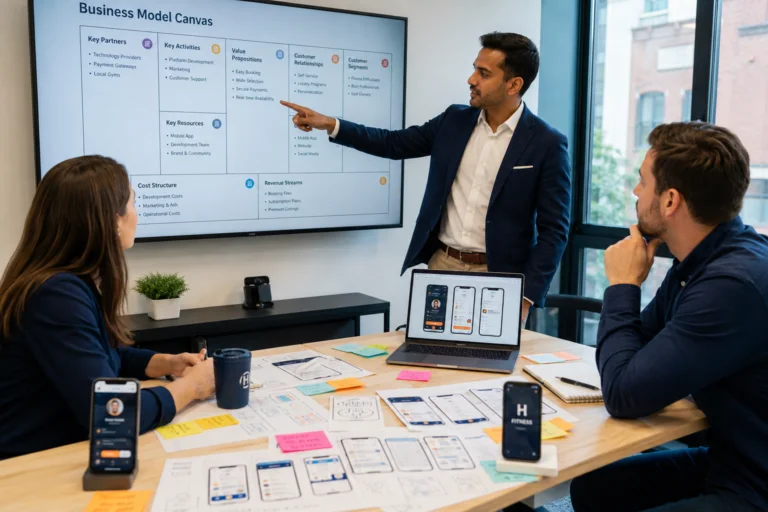
Mobile app development can create significant opportunities for businesses, but it also involves technical, financial, security, and operational risks. Poorly defined requirements, unrealistic timelines, compatibility problems, security weaknesses, unexpected costs, and inadequate testing can all affect the success of an application.
Experienced mobile app development consultants help businesses identify these challenges before they become expensive problems. By combining technical knowledge with structured planning and risk management, consultants can make the development process more predictable and improve the chances of delivering a reliable, scalable application.
Understanding the Risks of Mobile App Development
Mobile applications operate across different devices, operating systems, screen sizes, network conditions, APIs, cloud services, and third-party technologies. This creates more complexity than simply designing an interface and writing code.
Common risks include changing requirements, scope creep, poor technology selection, integration failures, security vulnerabilities, performance problems, insufficient testing, and difficulties maintaining the application after launch. Identifying these risks early allows businesses to address them before they significantly affect the project.
Turning Business Requirements Into Clear Development Plans
One of the biggest sources of development risk is misunderstanding what the application actually needs to accomplish. A business may have a general idea for an app but lack clearly defined features, user journeys, technical requirements, or success metrics.
Consultants help transform business objectives into detailed development requirements. They can organize features according to priority, identify dependencies, define user flows, and distinguish essential functionality from features that can be introduced later.
A clearer scope reduces misunderstandings between business stakeholders and developers and provides a stronger foundation for estimating time, resources, and costs.
Choosing the Right Technology
Technology decisions made at the beginning of a project can influence its performance, scalability, maintenance requirements, and long-term cost.
Consultants can evaluate whether native development, cross-platform frameworks, cloud services, APIs, databases, or other technologies are appropriate for the specific project. Rather than selecting technology simply because it is popular, they can consider factors such as the target audience, required functionality, expected growth, security requirements, development resources, and future maintenance.
This approach helps reduce the risk of building an application on a technical foundation that becomes difficult or expensive to change later.
Controlling Scope Creep
Scope creep occurs when additional features and requirements gradually enter a project without adequate consideration of their effect on the budget and schedule.
Consultants can establish a structured process for evaluating new requirements. Features can be categorized according to business value, urgency, technical complexity, and development effort.
Instead of continuously expanding the original project, businesses can prioritize a minimum viable product and plan additional capabilities for future releases. This helps development teams maintain focus while allowing the application to evolve.
Identifying Technical Problems Early
Some technical problems become significantly more expensive when discovered near the end of development. Architecture limitations, integration issues, performance bottlenecks, and incompatible components may require substantial rework if they are not identified early.
A consultant can review the proposed architecture and identify potential weaknesses before extensive development begins. Technical prototypes or proof-of-concept implementations can also be used to test uncertain components.
Early validation gives businesses an opportunity to change direction before large amounts of time and money have been invested.
Strengthening Mobile App Security
Security is another major area of development risk. Mobile applications can handle personal information, payment details, authentication credentials, business data, and communications with backend systems.
Security should therefore be considered throughout the development lifecycle rather than treated as a final pre-launch activity. NIST guidance emphasizes defining security requirements, testing applications, and evaluating vulnerabilities as part of the application vetting process.
Consultants can help establish practices involving secure authentication, data protection, API security, permissions, encryption, secure coding, dependency management, and security testing. This can reduce the likelihood of vulnerabilities reaching production.
Improving Testing and Quality Assurance
Mobile apps must work across different devices, operating system versions, screen sizes, hardware configurations, and network environments. Testing only one device or one operating system can therefore leave important problems undiscovered.
Consultants can help create a testing strategy that includes functional testing, compatibility testing, performance testing, regression testing, usability testing, and security testing. Industry guidance also recommends comprehensive testing because the variety of mobile environments can make mobile testing particularly challenging.
Automated testing can further help teams identify regressions as new features are introduced.
Managing Third-Party Dependencies
Many modern applications rely on external APIs, software libraries, payment systems, analytics platforms, authentication services, cloud infrastructure, and other third-party components.
Although these technologies can accelerate development, they also introduce dependencies. An external service may change its API, become unavailable, introduce security concerns, or stop receiving adequate support.
Consultants can help evaluate third-party technologies before they are incorporated into an application and establish strategies for monitoring dependencies. This reduces the risk of becoming unnecessarily dependent on unreliable or outdated components.
Reducing Budget and Timeline Uncertainty
Unexpected technical work is one of the main reasons app projects experience budget and schedule problems. A project may initially appear straightforward but become more complicated because of integrations, security requirements, testing needs, or changes in scope.
Experienced consultants can help businesses create more realistic estimates by breaking the project into smaller components. Milestones, priorities, dependencies, and potential technical challenges can be considered before development begins.
While no estimate can eliminate uncertainty completely, better planning can make financial and scheduling risks easier to manage.
Planning for Scalability
An application that works for a small number of users may not automatically perform well when its audience grows.
Consultants can consider scalability during architecture planning by evaluating databases, APIs, cloud infrastructure, caching, storage, authentication, and application performance. Designing with future growth in mind can prevent businesses from having to rebuild major parts of an application when demand increases.
Scalability does not necessarily mean overbuilding the first version. Instead, it means creating an architecture that can evolve as business requirements change.
Supporting Better Project Communication
Communication problems can create both technical and business risks. Developers may interpret requirements differently from stakeholders, while business teams may not fully understand the technical consequences of requested changes.
Consultants can act as a bridge between technical and nontechnical stakeholders. They can translate business objectives into technical requirements and explain technical decisions in practical business terms.
Regular progress reviews, documentation, milestone discussions, and risk assessments can also help stakeholders discover problems before they become major obstacles.
Preparing for Launch and Post-Launch Support
Development risks do not disappear when an app is published. New operating system versions, security vulnerabilities, device changes, third-party API updates, and user feedback can create new challenges after launch.
A strong post-launch strategy should include monitoring, bug fixes, performance analysis, security updates, and planned improvements. Security guidance recommends continuing assessment and testing during maintenance because updates and changes can introduce new vulnerabilities.
Consultants can help businesses establish a maintenance roadmap so the application remains reliable after its initial release.
Making Risk Management Part of the Entire Lifecycle
Effective risk management is not a single meeting held at the beginning of development. It should continue from requirements gathering through design, development, testing, deployment, maintenance, and eventual replacement or decommissioning.
Security-focused mobile development guidance similarly recommends incorporating security considerations across requirements, design, development, testing, pre-production, and maintenance.
This lifecycle approach allows businesses to identify emerging problems and adjust their strategy as the project evolves.
Conclusion
Mobile app development involves more than writing code. Businesses must make decisions about requirements, technology, security, testing, integrations, budgets, scalability, and long-term maintenance. Mistakes in any of these areas can increase costs and delay the final product.
Working with mobile app development consultants can help businesses approach these challenges systematically. Consultants provide technical insight, strategic planning, risk assessment, quality assurance guidance, and lifecycle support. By identifying potential problems early and establishing practical processes for managing them, businesses can reduce uncertainty and create a stronger foundation for a successful mobile application.
The goal is not to eliminate every possible development risk. Instead, it is to identify important risks early, prioritize them intelligently, and establish solutions before they become expensive problems.
