

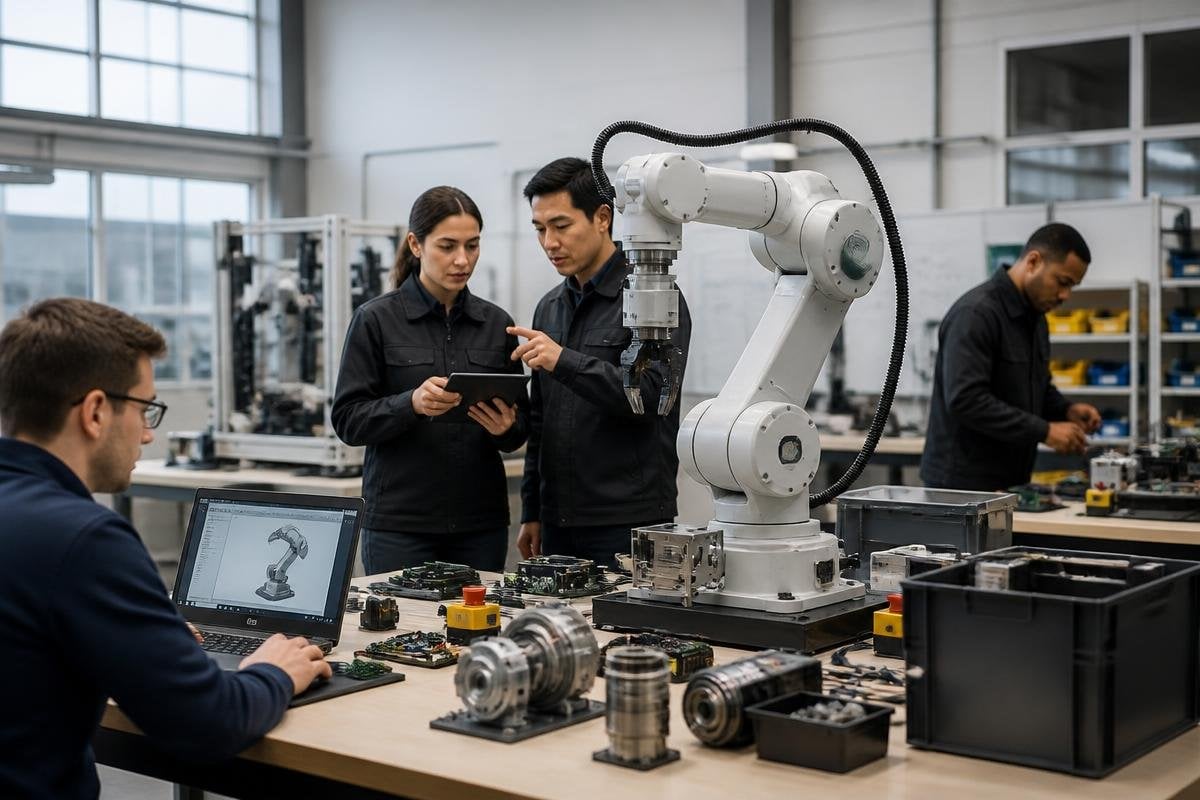
The robot economy starts before a robot reaches a customer. It needs parts, software, repairs, training, safety checks, and people who can fit the system into real work. The useful question is not how many robots exist, but where money changes hands around them.
- Robots need more than hardware sales
- Service work may last longer than a product launch
- Proof of paid use matters more than a polished demo
The machine is only one part
Taken together, physical parts and software make a robot a working system. Motors create movement, sensors collect information, and a controller turns that information into an action. Each part creates a separate need for design, supply, testing, and repair.
That structure spreads money across several firms. One company may build the arm, another may make the camera, and a third may write software for a factory task. The customer may buy the finished system, but many suppliers earn money before installation day.
The same pattern applies to mobile robots. A warehouse vehicle needs wheels, batteries, charging equipment, maps, safety sensors, and software that connects it to orders. A machine that cannot fit the site’s floor plan or work rules has little use, even if its hardware runs well in a test area.
Services turn a sale into a business
Installation is where many robot projects meet the real workplace. A supplier has to study the task, set safe speeds, connect the robot to existing equipment, and train the people who work nearby. Those jobs need time on site and repeat visits when the process changes.
Maintenance adds another stream of work. Motors wear, cameras get dirty, batteries lose capacity, and software needs updates. A supplier that can replace a part quickly may keep the customer running, while a cheap machine with slow repair support can cost more during a shutdown.
This is why service contracts matter. They can cover spare parts, remote checks, software updates, and visits from technicians. The contract terms decide who pays when a gripper fails or a robot stops because the floor layout changed.
A technician visit can turn a promised labor saving into paid support work. Reports at Robot24 connect the robot’s task with the people still needed to install, repair, and supervise it.
Paid work is the test
The strongest sign of a robot business is repeated paid use. A one-day demo shows that a machine can perform a task under chosen conditions. A long-running site shows whether the robot can keep working when people move nearby, objects vary, and repairs take time.
That difference matters to buyers. A factory manager needs the cost of the full system, the hours it can run, the staff needed to supervise it, and the result after maintenance.
Cutting one task from ten minutes to six may matter if that task runs all day. The same saving may have little value if the task happens twice per shift.
No evidence pack supports a market-size claim here, so a precise count of robot jobs, sales, or deployments would be made up. A sound report needs named companies, dated filings, customer sites, prices, or measured results before it gives those claims space.
What to check before calling it a robot business
The label can cover a maker, a software supplier, a repair firm, or a training provider. Use this checklist before you judge the business:
- Name the buyer. Write down who pays and which task they need done.
- Price the full system. Add hardware, installation, software, training, and repair cover.
- Check the work period. Ask how long the robot has run outside a staged demo.
- Find the failure plan. Confirm who replaces parts and how long a repair takes.
- Measure the result. Compare paid output, staff time, downtime, and energy use.
These checks also show where new firms may enter the market. Some will sell machines, while others will fit robots into old factories, manage fleets, train staff, or repair equipment. The work around robots may become a larger source of income than the first hardware sale, but that claim still needs customer records and dated results.
I’d wait for those records before calling a robot company a lasting business. The next useful proof is simple: a named customer, a paid deployment, a measured result, and enough service history to show the system kept working.
